
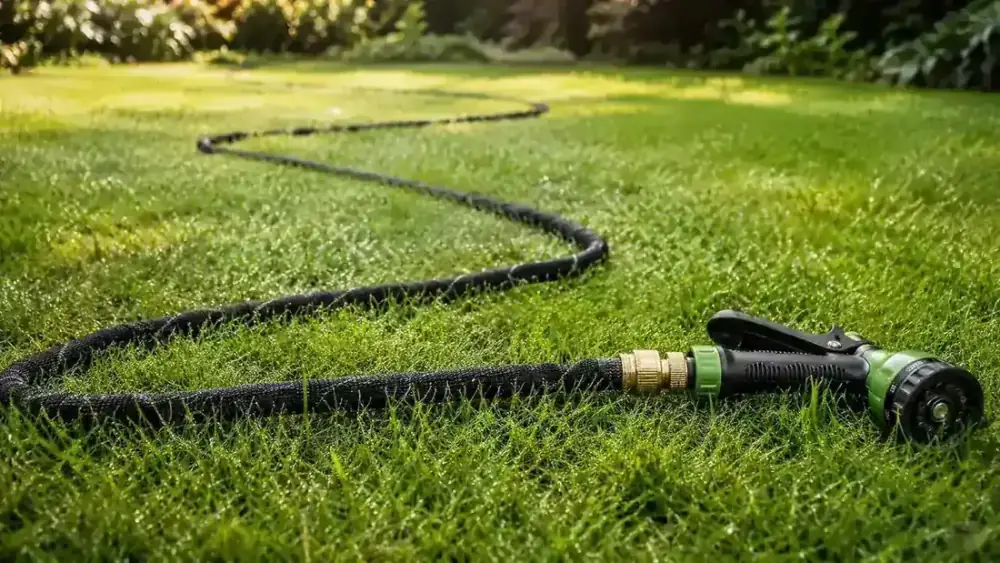
Here is something that does not make it into most expandable hose reviews: the Flexi Hose 50FT has a 4.1-star average across 26,827 Amazon reviews. Not 4.5. Not 4.7. Four point one. For reference, the VIVOSUN pruner I keep next to my potting bench has 64,000 reviews and sits at 4.6. The Flexi Hose is not a bad product. But 4.1 means there is a real percentage of buyers who had a real problem, and I wanted to find out who they were and whether I would be one of them before I made the purchase. So I did what I always do: I bought it, I read every one-star and two-star review I could find, and then I went outside and ran actual tests. This is what I found.
I want to be clear that this article is deliberately different from the longer-term review I wrote about using the Flexi Hose through two growing seasons. That piece covers daily use patterns, storage, and wear over time. This one is about what the marketing copy does not tell you, what the negative reviews are actually complaining about, and whether those complaints should change your buying decision.
The Quick Verdict
A solid expandable hose that earns its fan base but has specific, predictable failure modes the product listing will never warn you about. Know them going in and you will probably be happy.
Amazon Check Today's Price →Want the expandable hose with real brass fittings, not plastic ones that crack by July?
The Flexi Hose 50FT is on Amazon with over 26,000 reviews. Check today's price and see what current buyers are saying before you commit.
Amazon Check Today's Price on Amazon →What the Marketing Claims and What the Reality Is
Expandable hose marketing loves the words "no kink" and "flexible." Those words are doing a lot of work without being technically wrong. Here is the more precise version: the Flexi Hose does not kink under normal water pressure when the hose is fully expanded. That is accurate. What it leaves out is that the hose will kink if you try to use it while it is only partially expanded, if the water pressure is too low to push full expansion, or if you run it under a gate or through a small gap where the outer fabric cannot spread freely. The kink-free claim is conditional on the hose being at full pressure and full length. If those two conditions are not met, you are going to get a kink, and a kink under partial pressure can create a stress point in the inner latex tube that does not fully recover.
"50 feet" is also a conditional number. The hose measures about 17 feet when contracted and 50 feet when fully pressurized. In practice, the distance you can reach from your spigot is a few feet less than 50 because the expansion happens along the length of the hose and the last foot near the fittings does not expand as much as the middle section. It is close enough that I am not going to call it misleading, but if 50 feet is exactly the distance from your spigot to your farthest bed, you may find yourself a foot or two short on a low-pressure day when the hose does not quite reach full expansion.
Decoding the One-Star Reviews
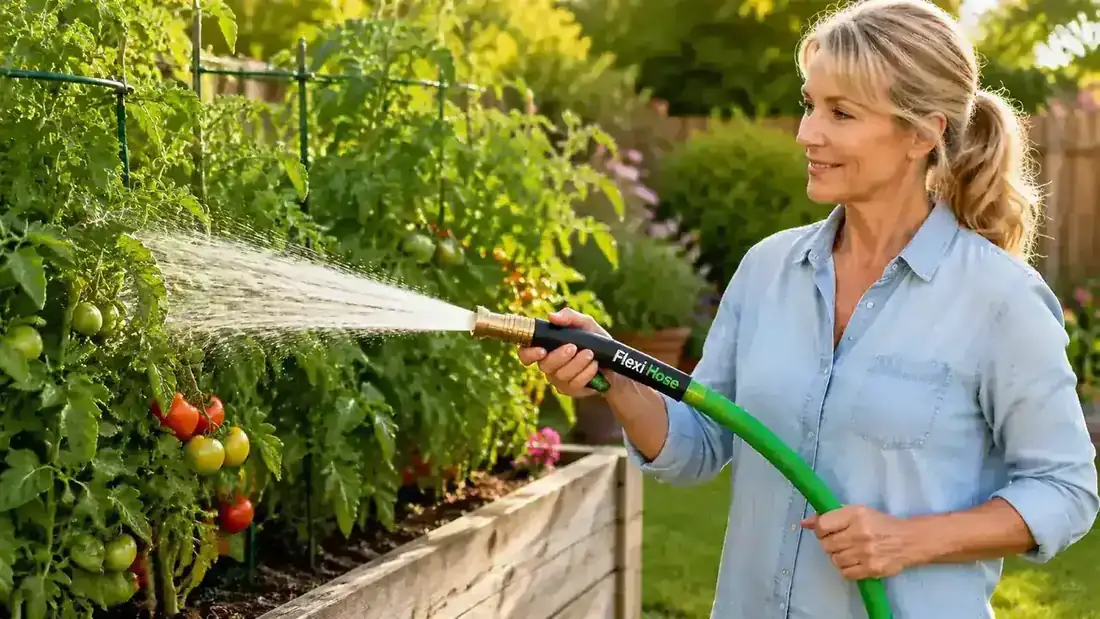
I read about sixty negative reviews before buying, and they sort into three buckets pretty cleanly. The first bucket is "it burst after X weeks." These reviewers almost always mention that the burst happened at a connection point or that they were running the hose at very high pressure. Expandable hoses are rated for typical residential pressure, which is 40 to 80 PSI. If your home's water pressure is on the high end of that range or above it, you are pushing the inner latex tube harder than it was designed for. A burst at a fitting is not random product failure. It is a physics problem.
The second bucket is "it started leaking at the connector." This is the one I find most useful because it is almost never the hose's fault and it is totally fixable before it becomes a problem. Every garden hose connection relies on a small rubber washer inside the fitting to create a watertight seal. On the Flexi Hose, those washers are adequate from the factory but they flatten and compress with repeat attach-detach cycles. After one season I noticed a slow drip at my spigot connection. I replaced the washer with a standard 3/4-inch hose washer from the hardware store (a pack of ten costs about two dollars) and the drip stopped immediately. That review category is preventable maintenance, not a product defect.
The third bucket is the hardest to argue with: "mine lasted one season." These are buyers who used the hose normally, stored it reasonably, and still saw the outer fabric fray or the inner tube develop a slow weep by the end of the first summer. I cannot tell you those reviewers are wrong. The Flexi Hose is not the most durable expandable hose on the market. It is the most durable in its price range, which is a different statement. If you have used three-season Gilmour and five-season rubber hoses and you expect the same life from a product at this price, you may be disappointed. If you are comparing it to other expandable hoses in the budget to mid-range tier, it holds up better than most.
Every garden hose connection relies on a small rubber washer to stay watertight. Replace it after one season with a two-dollar pack from the hardware store and the most common complaint about this hose disappears before it starts.
The Flow Rate Nobody Mentions
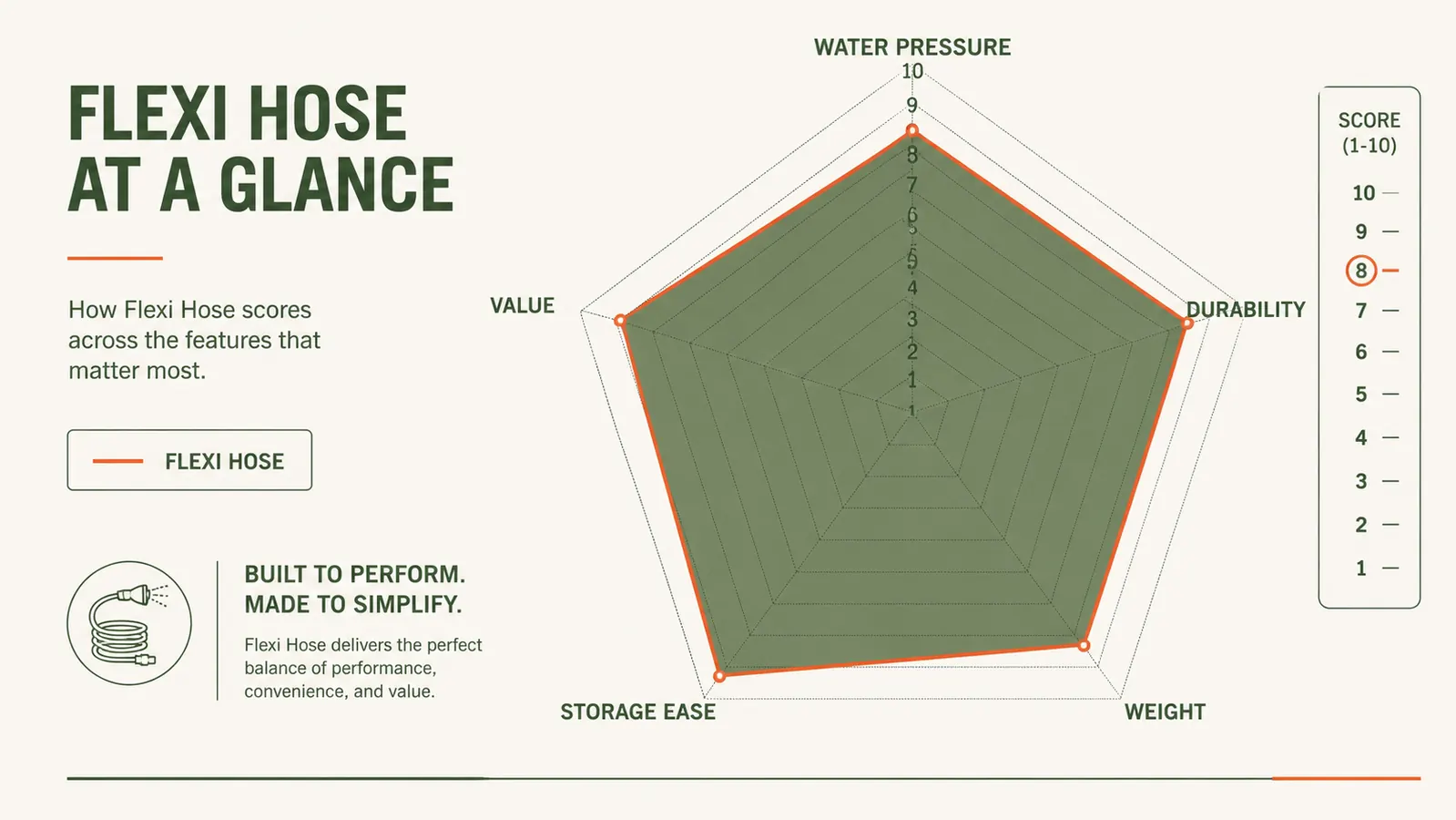
Here is the thing most expandable hose reviews skip entirely: the inner latex tube is narrower than the inner diameter of a comparable rubber hose. A standard 5/8-inch rubber garden hose delivers more water per minute at the same pressure than the Flexi Hose. In casual hand watering, you will not notice. You point the nozzle at a plant, water comes out, you move on. But if you are trying to fill a 30-gallon rain barrel quickly, run a sprinkler head, or supply a soaker hose connector that needs volume to work properly, the flow rate difference is noticeable.
I ran an informal test with a five-gallon bucket. My old 5/8-inch rubber hose filled it in 45 seconds at my spigot's normal pressure. The Flexi Hose took 62 seconds for the same five gallons. That is about a 25 percent drop in flow rate. For direct watering it does not matter at all. For filling containers fast or running certain irrigation attachments, it is worth knowing before you buy. If you need high volume as well as portability, an expandable hose in the 3/4-inch inner diameter category would close that gap, though they cost more and tend to be heavier.
Temperature and Pressure Do More Than You Think
I started noticing something in early spring and again in late fall: the Flexi Hose expands more slowly when the water is cold. Cold water is denser and does not push the latex tube out as enthusiastically as warm summer water does. At 50 degrees water temperature and my normal spigot pressure, the hose takes almost a full minute to reach its longest expansion. On a hot August afternoon with warmer water from sitting in the line, it reaches full extension in about thirty seconds. This is not a defect. It is just how rubber behaves with temperature. But if you are a morning waterer in a cool climate, plan for the hose to feel a little sluggish and stiff until it warms up.
Contraction after watering works the same way in reverse. On a hot afternoon, the hose contracts quickly once you shut off the spigot, draining itself in ninety seconds or so. On a chilly morning it may take three or four minutes to fully contract and you may need to lift the far end to help it drain if your yard does not have a slope working in your favor. For cold-climate gardeners who store the hose in fall, that slow drain matters for winterizing. Make sure it has fully contracted and drained before you bring it inside.
Three Specific Situations Where This Hose Will Frustrate You
The first is running it through or under a tight gap, like under a garden gate or through the gap in a fence panel. Rubber hoses do not care about this because they do not rely on internal water pressure to hold their shape. The Flexi Hose, pinched under a gate while under pressure, will not expand fully at that pinch point. The fabric can also chafe against a rough metal gate edge over a whole season and wear through at that spot faster than anywhere else on the hose. If you need to run the hose through a tight spot regularly, either route it over the top or stick with rubber for that application.
The second is connecting drip irrigation or soaker hose accessories. Drip emitters and soaker hoses need steady, even pressure and a consistent flow rate. The Flexi Hose's lower inner diameter means the flow rate varies a bit depending on how fully expanded it is and how cold the water is that day. For hand watering that is invisible. For drip systems that need to deliver a precise amount per emitter, it introduces a variable that a rubber hose does not. I would use a dedicated rubber soaker hose line off a splitter and keep the expandable for hand watering duties.
The third is high-pet-traffic areas. My neighbor's dog figured out the Flexi Hose was interesting to chew within a week of her buying one. The outer fabric is tougher than it looks but it is not chew-proof. Even mouthing and tugging at the fabric repeatedly can work the weave loose at a spot and expose the inner latex. If you have a dog that is interested in hoses, either keep it out of reach or accept that you may need to repair or replace it sooner than expected.
What the Included Nozzle Actually Does
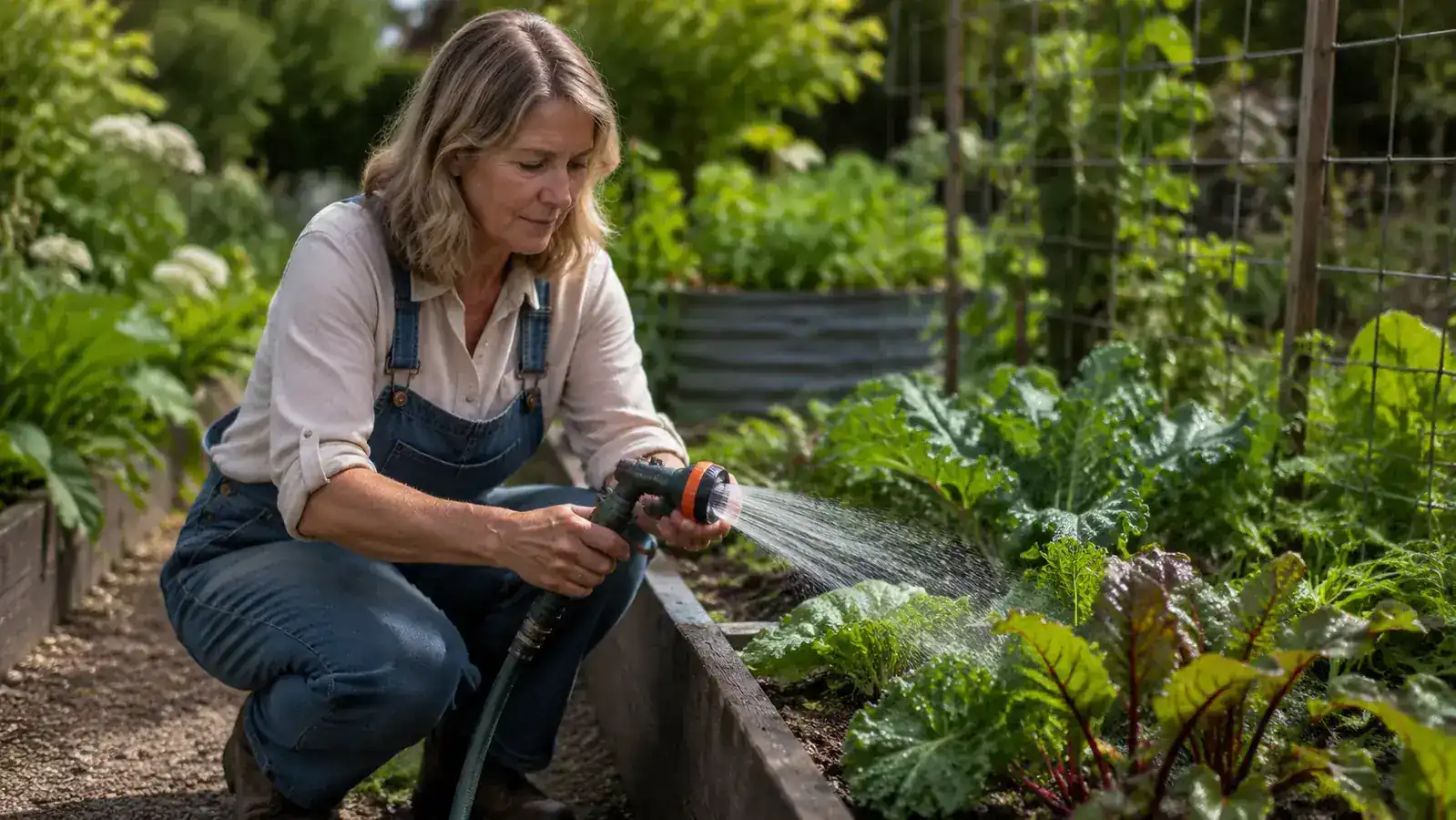
The Flexi Hose ships with an eight-pattern spray nozzle made of plastic. I want to give you a realistic picture of what you are getting. The nozzle works fine out of the box for the first season. It has the usual settings: jet, flat, center, full, shower, mist, cone, and soaker. For most casual watering they all do the job. The issue I have seen, and that several reviewers have confirmed, is that the twist adjustment stiffens and sometimes locks up by the second season. Mineral deposits from hard water combine with the plastic threading mechanism and make the nozzle hard to rotate. You can extend its life by rinsing it after use and not leaving it sitting in standing water, but eventually most plastic nozzles on hoses in this price range give out.
If you are going to water seedlings or containers regularly, upgrade to a dedicated brass nozzle with a separate shut-off from the start. You will get better water patterns, better longevity, and more control over flow without fighting a stiff plastic mechanism. The included nozzle is a bonus that gets you through the first season, not a long-term tool.
What I Liked
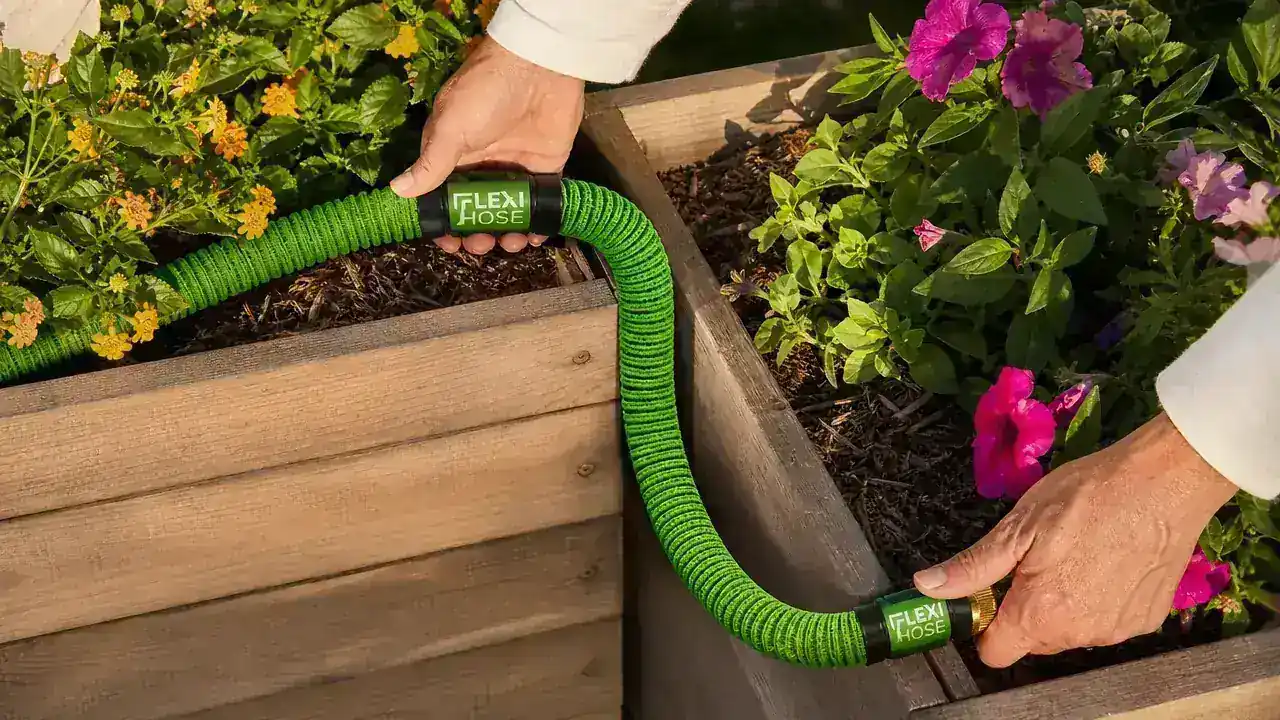
- Brass fittings on both ends do not crack or strip the way plastic connectors do on competing hoses
- Kink-free under full pressure in normal open-space use, genuinely better than rubber in that condition
- Lightweight enough to handle with one hand even at full 50-foot extension
- The connector leaking problem is fixable with a two-dollar hose washer replacement, not a product defect
- Contracts and stores in a fraction of the space of a rubber hose, no reel required
- Outer fabric gives the inner latex meaningful UV protection in direct sun climates
Where It Falls Short
- Flow rate is roughly 25 percent lower than a comparable rubber hose at the same pressure
- Kink-free claim is conditional on full pressure and full expansion, not valid in tight gaps or partial pressure
- Cold water slows expansion and contraction noticeably in spring and fall
- Included plastic nozzle tends to stiffen and lock up after one to two seasons
- Inner tube narrower than rubber hose alternatives, limiting compatibility with soaker and drip irrigation attachments
- 4.1-star average reflects a real subset of buyers who had durability issues before the second season
Who This Is For
If you do most of your watering by hand, you water a home garden or yard under about a quarter acre, and you are using a standard residential spigot at normal household pressure, the Flexi Hose is a good fit. It is especially well suited for gardeners who value easy storage and portability over maximum durability, people who want to leave the hose reels and wall mounts behind, and anyone who has dealt with a heavy rubber hose and a sore shoulder one too many times. It is also a strong choice for people who want to bring a hose to different parts of a yard or property without committing to a fixed hose reel in one location. For straightforward, daily hand watering use, the tradeoffs are easy to manage once you know about them. For more detail on using the Flexi Hose in a full daily routine, see our two-season Flexi Hose review, which covers the day-to-day experience in depth.
Who Should Skip It
Skip the Flexi Hose if your water pressure is above 80 PSI (run it through a pressure regulator first if you are not sure and your home has notoriously high pressure). Skip it if you need to run it through a tight gap, route it under a gate, or connect it to drip irrigation that needs a consistent flow rate. Skip it if you have a dog with a taste for garden equipment, a yard covered in rough gravel paths, or a habit of leaving the hose pressurized and kinked while you take a long lunch break. And skip it if you need to fill large containers or supply a sprinkler that needs a higher water volume than the narrower inner tube can provide. In those situations a heavy-duty rubber hose or a professional-grade 3/4-inch expandable is a better tool. For a full side-by-side look at how the expandable design compares to a standard rubber hose by specific use case, the Flexi Hose vs Regular Garden Hose comparison walks through each scenario.
Know exactly what you are buying and it is a solid hose for the money.
The Flexi Hose 50FT expandable garden hose with brass fittings has over 26,000 Amazon reviews. Check today's price and read what current buyers are saying about how it holds up season to season.
Amazon Check Today's Price on Amazon →